
Guides
Nicotine Pouch Side Effects

Oct
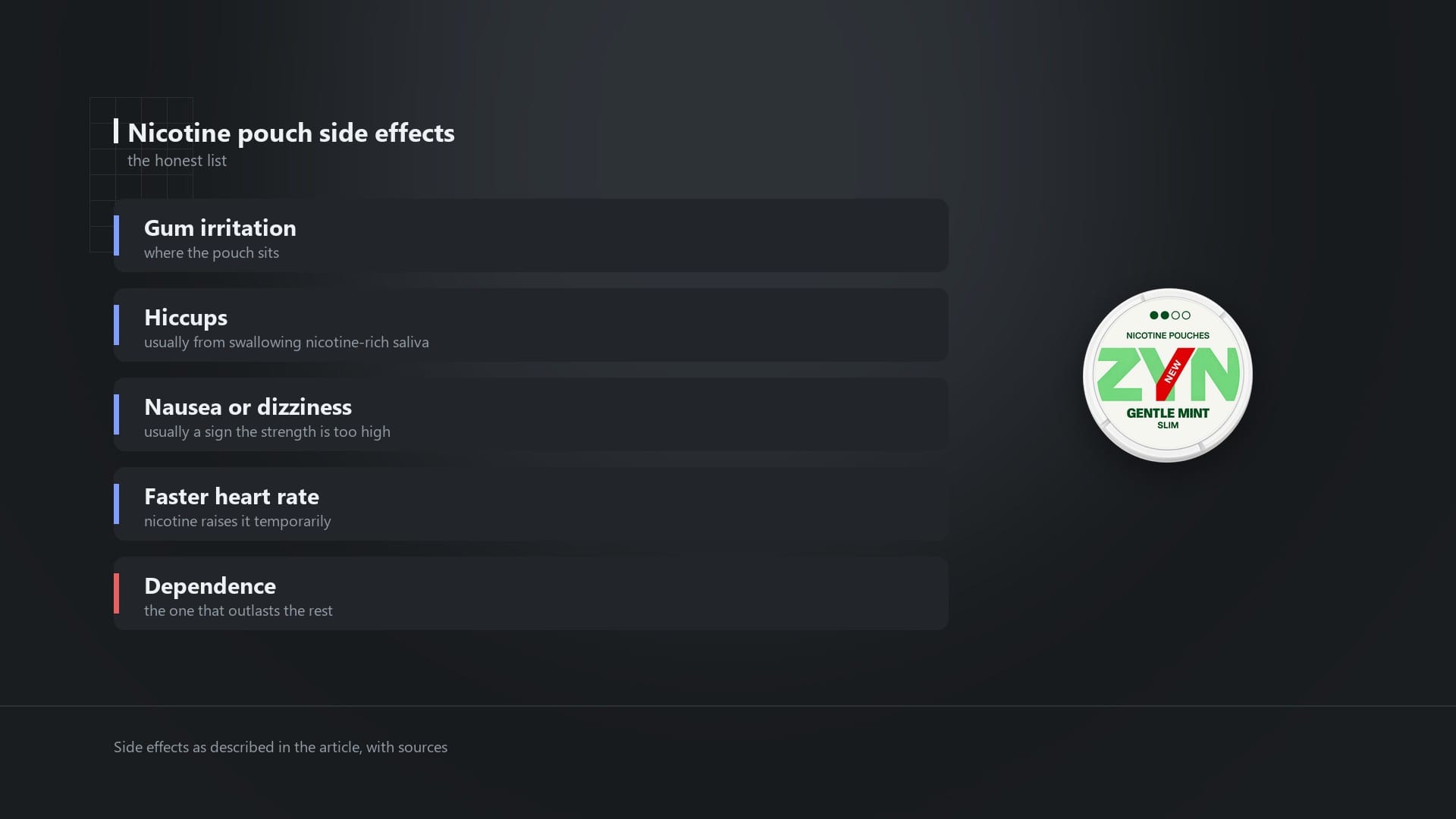
The common nicotine pouch side effects are local and mild — gum irritation where the pouch sits, hiccups, and nausea or dizziness when the strength is too high for you. Nicotine itself temporarily raises heart rate and blood pressure and is genuinely addictive, which is the side effect nobody should minimise. Serious problems are rare in healthy adults and cluster around overuse, and the honest caveat is that pouches are young enough that long-term data is still thin. Here is the full list, why each one happens, and what actually reduces them.
We sell these products, so read this with that in mind — and notice that it would be easier for us not to publish a side-effects page at all. We would rather you buy the right strength, use it sensibly and come back, than have a miserable first week at a tier you were never meant to start at.
Nicotine pouch side effects: what users actually report
Across user reports and the published literature, the side effects worth knowing about are:
- Gum and mouth irritation at the placement spot — the most common complaint by a distance.
- Hiccups, usually from swallowing nicotine-rich saliva.
- Nausea, dizziness and cold sweats — the too-much-nicotine trio.
- A raised heart rate and blood pressure for a while after each pouch.
- Sleep disruption when pouches are used late in the evening — nicotine is a stimulant.
- Reduced appetite, which some users count as a feature and honesty counts as an effect.
- Dependence. The quiet one, and the one that matters most.
Why the mouth takes the hit
A pouch sits against one patch of gum for twenty to sixty minutes while nicotine and flavourings absorb through the tissue. That spot gets a concentrated, slightly alkaline bath, and the early result for many users is tingling, a mild burn, or a white, toughened patch where the pouch usually sits. The single best countermeasure is boring: rotate the placement spot so the same square centimetre of gum is not doing every shift, and keep sessions on the shorter end while your mouth adapts. If a spot stays sore or a lesion does not heal after you stop placing pouches there, that is a dentist conversation, not a forum one.
If you are brand new and want the technique itself — placement, timing, what the first ten minutes feel like — our how-to guide walks through it step by step.
The too-strong trio: nausea, dizziness, cold sweat
Nausea, dizziness and cold sweats almost always mean the pouch is too strong for you. Nausea, light-headedness and sweating are the body’s standard response to more nicotine than your tolerance is calibrated for, and they arrive in a fairly predictable escalation — often with hiccups or a hot throat as the early warning. The fix is not toughing it out. Take the pouch out, and next session go down a tier. Our strength chart lays out every tier from 6 mg to 50 mg, and the Strength Finder will place you honestly in three questions. If in doubt, the rule that never fails: start at 6 mg and adjust upward slowly, because stepping up is always easier than un-learning a bad first impression.
How many pouches a day is normal also matters here — spacing, daily counts and the signs you are overdoing it get their own treatment in our usage guide.
Heart rate, blood pressure and the nicotine itself
Nicotine is a stimulant, so it raises heart rate and blood pressure while it’s active. Each pouch temporarily raises heart rate and blood pressure, whatever the delivery method — pouch, gum, patch or cigarette. The UK Royal College of Physicians’ landmark Nicotine without smoke report is the standard reference for the wider point: the overwhelming harm from smoking comes from the smoke, not the nicotine — but that is a statement about relative risk, not a clean bill of health for nicotine. A 2025 narrative review in Frontiers in Public Health lists raised heart rate and blood pressure among the immediate effects of nicotine pouches and names long-term cardiovascular effects as an open question, so anyone with existing heart disease or hypertension should be especially careful. The literature also includes a published case report of acute nicotine toxicity from repeated heavy pouch use. Respect the compound.
Sleep and appetite
Nicotine can disrupt sleep and blunt appetite: a pouch at 10 p.m. is an espresso at 10 p.m. Users who report poor sleep are usually running pouches into the late evening, and the fix costs nothing: make the last pouch an early-evening one. Appetite suppression is equally well established — nicotine blunts hunger signals — and while some users treat that as a bonus, relying on a dependence-forming stimulant as an appetite manager is a bad trade, and we will not dress it up as anything else.
Dependence: the side effect that outlasts the others
Every other entry on this list fades with the right strength and sensible habits. This one compounds. Nicotine is genuinely addictive, tolerance builds over weeks, and the pattern we describe in our strength guides — people climbing the ladder without noticing — is dependence doing its quiet work. If you do not currently use nicotine, the only honest advice a nicotine shop can give is: do not start for the flavours. For smokers and vapers switching over, the calculus is different — we walk through the published comparisons in pouches vs smoking — but for a nicotine-naive user, the baseline you are comparing against is zero.
What the research does and does not cover
Modern white pouches have only been mass-market products for around a decade, so the long-term epidemiology simply does not exist yet. What we do have: chemical analyses like the German federal risk assessment by Mallock et al. showing toxicant levels far below combustible tobacco but also showing that nicotine content varies enormously between products — which is exactly why strength discipline matters — and a growing review literature, including independent 2025 work, that consistently lands on the same two notes: substantially lower toxicant exposure than smoking, and not risk-free. Anyone selling you certainty in either direction — harmless or catastrophic — is ahead of the evidence.
Who should not use nicotine pouches at all
Some people should not use nicotine pouches at all, and there’s no hedging on this one. Pouches are not for anyone under the legal age in their province, not for pregnancy or breastfeeding, not appropriate alongside serious heart conditions or uncontrolled high blood pressure without a doctor’s sign-off, and not for people who do not already use nicotine. That list is not fine print; it is the actual boundary of who this product is for.
Reducing side effects: the practical checklist
- Match your strength, never chase it. The chart and the finder exist for exactly this.
- Rotate placement so one gum spot is not absorbing every session.
- Shorten sessions — twenty to thirty minutes delivers most of what an hour does, with less irritation.
- Space pouches out and keep a real gap between them; back-to-back pouches are how the nausea trio arrives.
- Keep the last pouch early if your sleep is suffering.
- Take it out at the first warning sign — hiccups and a hot throat are the body asking politely.
Nicotine Pouch Side Effects FAQ
Do nicotine pouches damage your gums?
They can irritate them. Gum irritation at the placement spot is the most commonly reported side effect, and the practical fix is rotating where you place the pouch and using shorter sessions. Long-term gum-recession data specific to modern white pouches is still thin, which is a reason for moderation rather than alarm.
Why do nicotine pouches give me hiccups?
Swallowing nicotine-rich saliva irritates the nerves involved in the hiccup reflex. It is harmless but annoying, and it usually means the pouch is too strong or too wet for you. Dropping a strength tier or spitting out the first minute of saliva typically ends it.
Do nicotine pouches make you dizzy or nauseous?
They can, and it is almost always a dose problem: too strong a pouch, too long a session, or two pouches too close together. Nausea, dizziness and cold sweats are the classic signs of taking in more nicotine than your tolerance handles. Take the pouch out at the first sign and go down a strength.
Are nicotine pouches bad for your heart?
Nicotine temporarily raises heart rate and blood pressure regardless of how it is delivered. For healthy adults the medical consensus treats this as a modest effect, but anyone with a heart condition or high blood pressure should talk to a doctor before using any nicotine product.
Do nicotine pouch side effects go away?
The local ones usually do. Gum tingling and irritation typically ease as the placement spot toughens up over the first weeks, and dose-related nausea disappears once you find your right strength. Dependence is the side effect that does not fade with time; it deepens with it.
Bottom line
Used at the right strength by an adult who already uses nicotine, pouches’ day-to-day side effects are mostly minor, local and manageable — and dramatically fewer than the habit most of our customers switched from. Used carelessly — too strong, too many, too new to nicotine — they will make you feel awful, and the addiction is real either way. Start low, rotate, space them out, and browse the rest of our nicotine pouch guides when you want the deeper dives.
Sources
- Royal College of Physicians — Nicotine without smoke: tobacco harm reduction (2016)
- Mallock N. et al., German Federal Institute for Risk Assessment (BfR) — “Levels of nicotine and tobacco-specific nitrosamines in oral nicotine pouches,” Tobacco Control (2024)
- Case report: “Nicotine Toxicity From Repeat Use of Nicotine Pouches,” Nicotine & Tobacco Research (2025)
- Al-Otaibi H.M. et al., “Nicotine pouches: a narrative review of the existing literature,” Frontiers in Public Health (2025)
Nicotine is addictive. Our products are for adult nicotine consumers of legal age (19+ in most provinces). If you don’t currently use nicotine, don’t start. Nothing on this page is medical advice — talk to a healthcare professional about your own situation.
