
Guides
Nicotine Pouches vs Smoking
Oct
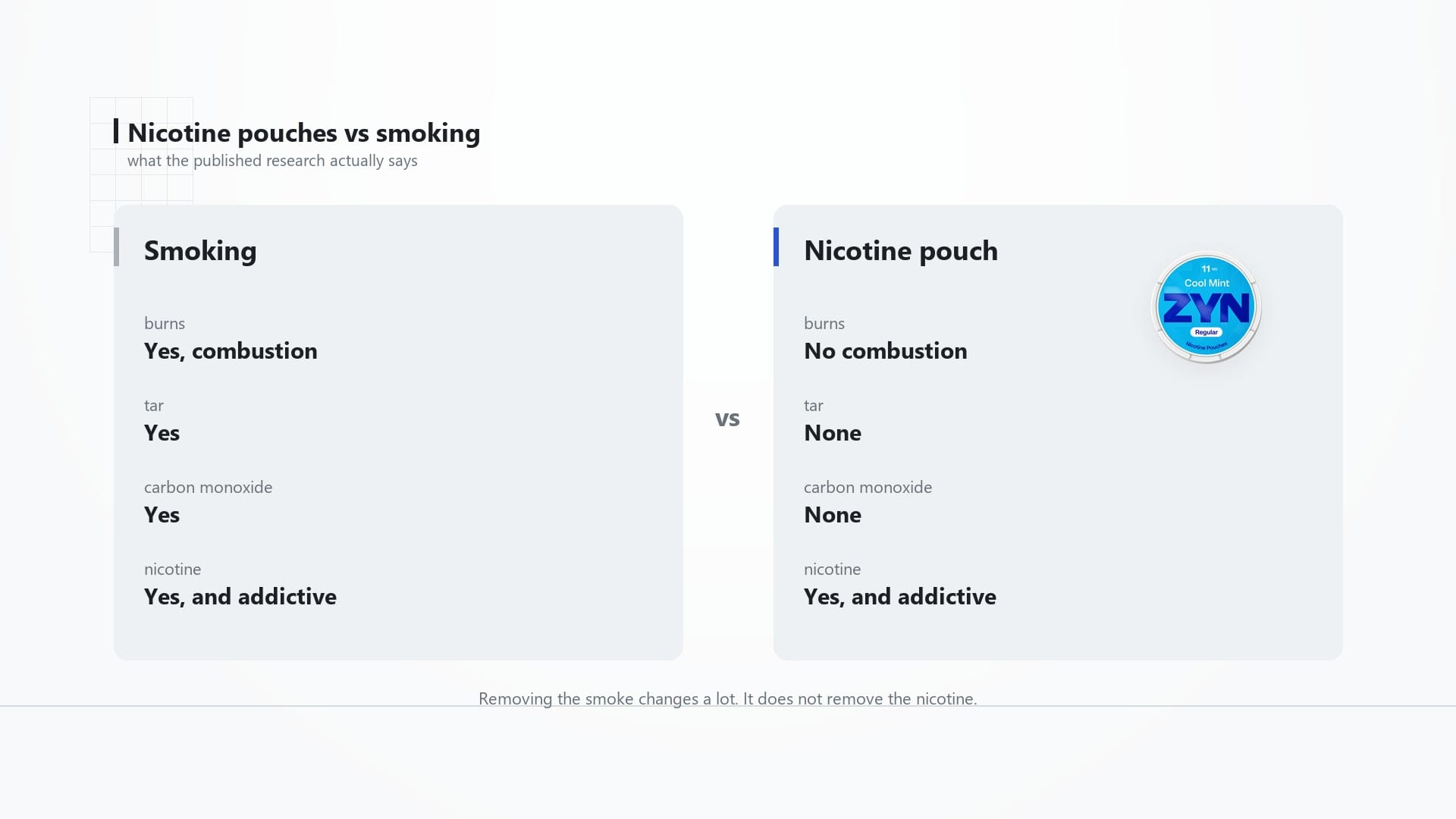
The big difference between nicotine pouches and smoking is that pouches remove the part of smoking that does most of the damage — the smoke. No combustion means no tar, no carbon monoxide, and none of the thousands of by-products created by burning tobacco. Published chemical analyses consistently place pouches at the low end of the toxicant spectrum among nicotine products. That does not make them safe: nicotine is addictive at any strength, the long-term evidence is still young, and if you don’t use nicotine, none of this is an invitation. But for adult smokers weighing a switch, here’s what the research actually shows.
Where smoking’s harm actually comes from
The public health consensus, stated plainly for decades: smokers are harmed overwhelmingly by the smoke, not the nicotine. Burning tobacco creates tar, carbon monoxide and thousands of combustion chemicals — dozens of them carcinogenic — and it’s this chemistry that drives lung cancer, COPD and most smoking-related heart disease. The UK’s Royal College of Physicians put it directly in their landmark report Nicotine Without Smoke: the harm from smoking comes principally from the smoke, and nicotine itself, while addictive, is not the main culprit in smoking’s death toll.
That distinction is the entire logic of smoke-free nicotine: keep the substance the smoker is dependent on, remove the delivery method that’s killing them.
Nicotine pouches vs smoking: what the chemistry studies show
Because nicotine pouches contain no tobacco leaf and burn nothing, the question researchers ask is: what’s actually in them, and how do their toxicant levels compare to cigarettes and snus?
- A German federal risk-assessment (BfR) analysis of dozens of pouch products — Mallock et al., published in Tobacco Control — measured tobacco-specific nitrosamines (the signature carcinogens of tobacco products) at levels far below traditional tobacco, in many products near detection limits. The same study still found these nitrosamines in 26 of the 44 pouches it tested, which its authors called a serious concern, and it described the nicotine content of some products as alarmingly high. The same study still found these nitrosamines in 26 of the 44 pouches it tested, which its authors called a serious concern, and it described the nicotine content of some products as alarmingly high.
- An industry-published chemical characterization — Azzopardi et al., Drug and Chemical Toxicology (2022) — positioned modern oral pouches at the lowest end of the toxicant continuum among nicotine products, below snus and far below cigarettes. (Worth knowing: this study came from a tobacco-industry lab — we cite it alongside independent work, not instead of it.)
- A 2025 independent narrative review in Frontiers in Public Health surveying the pouch literature reaches the cautious consensus: substantially fewer and lower toxicants than combustible tobacco, with meaningful long-term health data still years away.
What pouches don’t fix
An honest ledger has a second column:
- Nicotine addiction, fully intact. Pouches deliver the dependence-forming substance efficiently. Switching from smoking changes what nicotine rides in on; it doesn’t end the relationship.
- Nicotine’s own effects. Temporarily raised heart rate and blood pressure, and it’s not appropriate for pregnancy or people with certain heart conditions — regardless of delivery method.
- Overuse is real. Medical literature includes case reports of nicotine toxicity from heavy pouch use — our usage guide exists for a reason.
- Unknowns. Pouches are young products. Gum and oral effects, long-horizon outcomes — the studies are underway, not concluded. Anyone claiming certainty in either direction is ahead of the evidence.
For smokers considering the switch
We’re a store, not your doctor — and pouches are not an approved smoking-cessation therapy in Canada (that lane belongs to authorized NRT products; our ZYN vs Zonnic guide explains that landscape). What we can tell you is what switching customers consistently get wrong and right:
- Match your strength honestly. A pack-a-day smoker who buys 6 mg pouches ends up unsatisfied, doubles up, and drifts back to cigarettes. Our strength chart maps cigarette habits to pouch tiers, and the Strength Finder does it in three questions.
- Expect a different rhythm. A pouch is a 30–45 minute slow release, not a 5-minute spike. The first week feels different; most switchers stop noticing by week two.
- Don’t run both. Smoking and pouching stacks nicotine and keeps the smoke. The evidence story above only applies to actually switching.
The bottom line, stated carefully
Best case for anyone’s health is no nicotine at all — and if quitting entirely is on your table, take that route and talk to a healthcare provider. For adult smokers who aren’t going to quit nicotine, the published chemistry consistently shows smoke-free pouches sit at the low end of the toxicant spectrum, a long way from the combustion products doing the damage. That’s the research picture: meaningful, promising, and still incomplete.
Nicotine Pouches vs Smoking FAQ
Are nicotine pouches safer than smoking?
The chemical evidence says pouches expose users to far fewer and lower toxicants than cigarette smoke. “Safer than smoking” is not the same claim as “safe” — nicotine remains addictive and pouches aren’t risk-free.
Do nicotine pouches cause cancer?
The signature tobacco carcinogens (TSNAs) measure at trace-to-undetectable levels in published pouch analyses — a fraction of tobacco products. Long-term human data doesn’t exist yet; no honest answer goes further than that.
Can pouches help me quit smoking?
They’re not authorized cessation products in Canada, and we don’t market them as such. Some smokers use them to move off cigarettes; the authorized quit-smoking route is NRT and a conversation with your doctor.
What about pouches vs vaping?
Different comparison — both are smoke-free, and they differ on other axes. We’re covering that one separately soon.
Nicotine is addictive. This article is general information, not medical advice, and our products are for adult nicotine consumers of legal age (19+ in most provinces). If you don’t use nicotine, don’t start.
