
Guides
What Are Nicotine Pouches Made Of?
Oct
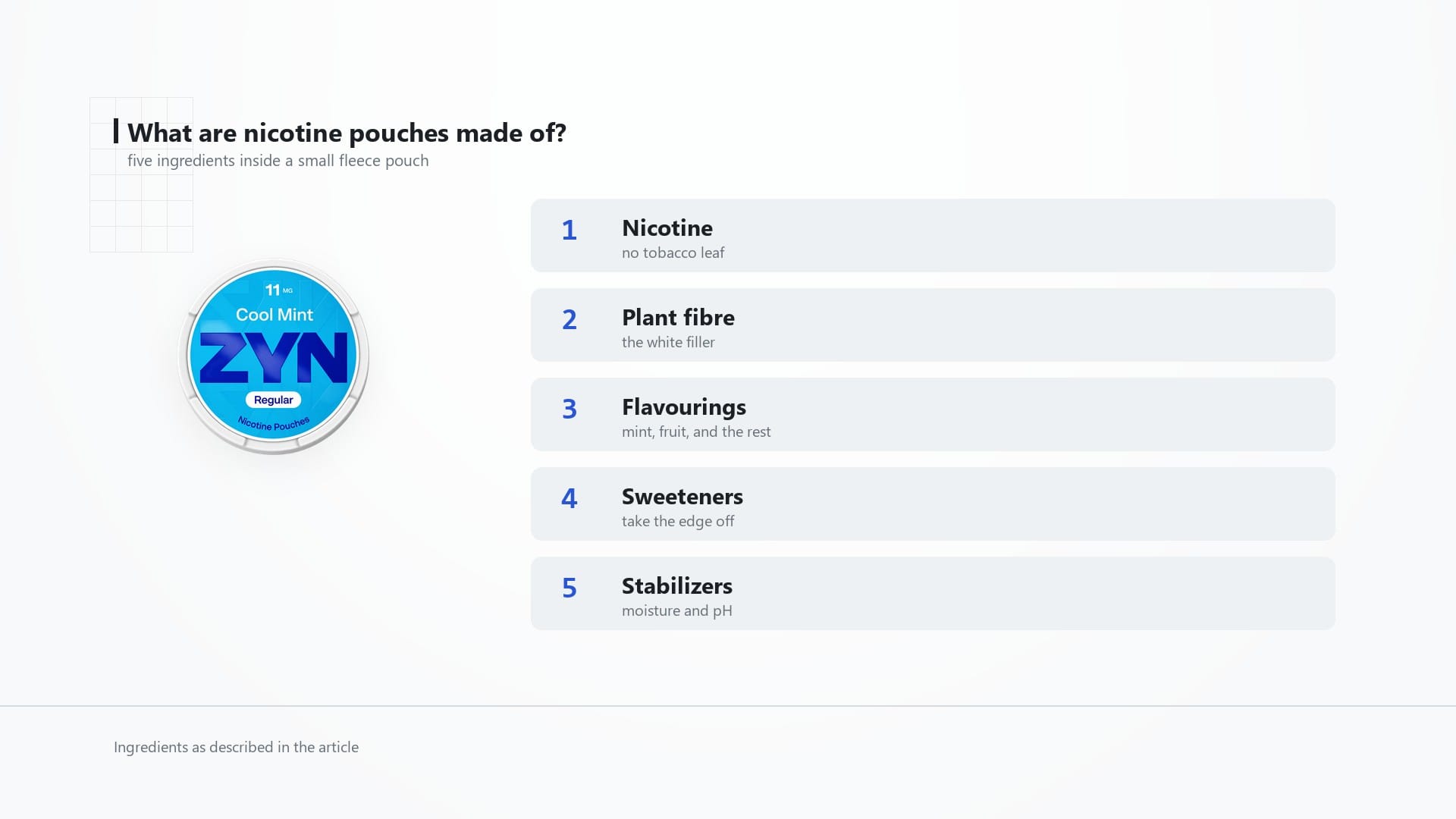
Nicotine pouches are made of five things: nicotine (usually synthetic or tobacco-derived salt, but no tobacco leaf), plant-based filler fibres (typically eucalyptus or pine cellulose), flavourings, sweeteners, and moisture stabilizers, all inside a small fleece pouch similar to a tea bag. That’s the whole recipe. Here’s what each part actually does.
What are nicotine pouches made of? The five ingredients
1. Nicotine (without the tobacco)
This is the entire point of the product, and the most misunderstood part. Modern white pouches contain nicotine salt or pharmaceutical-grade nicotine, not ground tobacco leaf. That’s what “tobacco-free” and “all-white” mean on the tin: the nicotine was extracted (or synthesized), purified, and added to a plant-fibre base. It’s also why pouches don’t stain teeth the way snus or chewing tobacco does. The amount per pouch is the mg number on the lid, and our strength chart breaks down what those numbers feel like.
2. Plant-based filler
The white bulk of the pouch is cellulose fibre, most commonly from eucalyptus or pine, the same food-grade cellulose used in countless everyday products. It has no flavour and no active role; it gives the pouch its body, holds everything in place, and carries the nicotine and flavour so they release gradually rather than all at once.
3. Flavourings
Food-grade flavourings, the same category used in gum and candy. This is where brands differentiate: ZYN’s range runs from mint oils to the candy-shop end (Gummy Bear, Cola Ice), while White Fox concentrates on intense mint. Flavour load also affects how a pouch feels; heavily mentholated pouches produce that cold “burn” some users love.
4. Sweeteners
Usually acesulfame K, sucralose or similar high-intensity sweeteners in tiny amounts — enough to round off bitterness (nicotine itself is bitter) without making the pouch sugary. No sugar means nothing for oral bacteria to feed on, one of the practical differences from older tobacco products.
5. Moisture stabilizers and pH adjusters
Glycerol or propylene glycol keep the pouch from drying out, and a small amount of pH adjuster (typically sodium carbonate) keeps the environment slightly alkaline, which is what lets nicotine absorb through the mouth’s lining efficiently. Brands tune moisture differently: VELO’s moister pouch releases faster; White Fox’s drier portion builds slower and lasts longer.
What’s NOT in a nicotine pouch
- No tobacco leaf — that’s the defining difference from snus and dip.
- No combustion products — nothing burns, so there’s no tar, no carbon monoxide, no smoke chemistry.
- No sugar — sweetness comes from non-nutritive sweeteners.
None of which makes pouches harmless: nicotine itself is genuinely addictive, and that’s true regardless of how clean the delivery vehicle is. If you don’t currently use nicotine, the ingredient list isn’t an invitation.
Does the ingredient list differ brand to brand?
The recipe skeleton is nearly identical across ZYN, VELO, White Fox and Pablo; the differences are in proportions and quality control: moisture level, flavour intensity, pouch material softness, and nicotine strength ceiling. European-made pouches (which is everything we stock) are manufactured under EU consumer-product frameworks, with Swedish factories like White Fox’s GN Tobacco carrying decades of pouch-making heritage.
How the pouch itself is made
The white outer material is a soft cellulose fleece, heat-sealed around the filling, structurally a lot like a slim tea bag. It’s designed to let saliva in and nicotine + flavour out, while keeping the filler contained. Used pouches go in the garbage (many tins have a catch compartment in the lid); they’re not flushable and not chewable.
Nicotine Pouch Ingredients FAQ
Do nicotine pouches contain tobacco?
No. White pouches contain purified or synthetic nicotine on a plant-fibre base — no tobacco leaf. That’s the difference between pouches and snus.
Is the nicotine in pouches natural or synthetic?
Depends on the brand: some use nicotine extracted from tobacco plants (then purified), others use lab-synthesized nicotine. Functionally they’re the same molecule.
Are the ingredients safe?
The fillers, flavours and sweeteners are food-grade and widely used. The meaningful health consideration is the nicotine itself, which is addictive and not risk-free. Pouches remove the smoke and tobacco, not the nicotine. See our Pouches 101 guide for sensible-use basics.
Why does my mouth tingle or burn?
The mild burn is mostly the nicotine and pH adjusters doing their absorption job, amplified by menthol in cold flavours. It typically fades within minutes and lessens with regular use. A pouch that’s genuinely painful is probably too strong; our Strength Finder can place you better.
Nicotine is addictive. Our products are for adult nicotine consumers of legal age (19+ in most provinces). If you don’t use nicotine, don’t start.
Sources
- Al-Otaibi H.M. et al., “Nicotine pouches: a narrative review of the existing literature,” Frontiers in Public Health (2025)
- Mallock N. et al., German Federal Institute for Risk Assessment (BfR) — “Levels of nicotine and tobacco-specific nitrosamines in oral nicotine pouches,” Tobacco Control (2024)
